
The Dow Jones Industrial Average (DJIA) is one of the most authoritative and widely followed stock market indices in the world. Introduced by The Wall Street Journal more than 120 years ago in 1896, the Dow Jones initially tracked only the U.S. transportation sector. The original name “industrial index” has been preserved as a historical legacy, although today the DJIA represents 30 of the largest publicly traded U.S. companies across diverse sectors, including industrial manufacturing, finance, technology, retail, healthcare, and consumer services. As a key benchmark of the U.S. stock market, the Dow Jones index is widely used by investors and traders to analyze market trends, assess economic conditions, and support long-term investment and active trading decisions.
The Dow Jones Industrial Average (DJIA) live chart provides real-time price movements, intraday volatility, and key technical levels that are essential for both day trading and swing trading strategies. Traders use the live DJIA chart to identify short-term momentum, breakout zones, support and resistance levels, and trend direction across different timeframes. For active traders, intraday charts help capture quick price fluctuations during market hours, while swing traders rely on daily and weekly views to spot medium-term trend reversals and continuation patterns. Combined with technical indicators such as moving averages, RSI, and volume analysis, the live Dow Jones chart serves as a powerful tool for informed trading decisions and market timing.
Technical Analysis Dow Jones Futures
The Technical Analysis Dow Jones Futures widget provides traders and investors with a structured view of current market dynamics beyond simple price movements. It visualizes key technical indicators such as trend direction, support and resistance levels, momentum signals, moving averages, and volatility metrics, helping users identify potential day trading and swing trading opportunities. By combining real-time futures data with technical signals, the widget supports short-term trading decisions, risk management, and timing strategies across different market conditions.
Dow Jones Futures on the Stock Exchange
Dow Jones Index Futures track the performance of the Dow Jones Industrial Average (DJIA) and are widely used by traders and investors to gain exposure to the U.S. stock market beyond regular trading hours. The Dow Jones index itself is calculated during official NYSE trading hours from 9:30 a.m. to 4:00 p.m. (ET), while futures contracts reflect market expectations and react instantly to economic data, earnings reports, and geopolitical news throughout the day.
The derivatives market offers several types of Dow Jones futures contracts that differ by contract size, index multiplier, and tick value, making them suitable for both institutional investors and active retail traders. Futures prices closely follow the underlying index but often move ahead of the cash market, providing valuable signals for day trading, swing trading, hedging, and portfolio risk management.
Dow Jones futures are traded on CME Globex, an advanced electronic trading platform that operates nearly 24 hours a day, ensuring high liquidity, fast order execution, and global market access. In addition to futures, the derivatives market also offers options on Dow Jones futures, allowing traders to implement more sophisticated strategies such as volatility trading, income generation, and downside protection.
DJIA Futures Trading Hours
Unlike stocks traded on the cash equity market, Dow Jones Industrial Average (DJIA) futures are traded almost around the clock, offering traders extended access and higher flexibility. DJIA futures are traded on the CME Globex electronic platform from Monday to Friday, 5:00 PM to 4:15 PM (CT) the following day, with a daily maintenance break from 3:15 PM to 3:30 PM. During Asian and European trading sessions, futures prices may significantly diverge from the official index level due to lower liquidity and macroeconomic news flow.
Given that the Dow Jones index consists of U.S. blue-chip companies, historical price behavior shows that major declines are often followed by recoveries over time. As a result, long-term strategies such as buy-and-hold investing may help reduce the risk of permanent capital loss. However, traders and investors should exercise caution when using leverage, as excessive margin exposure can substantially increase downside risk during volatile market conditions.
Dow Jones Sub-Indices
The Dow Jones index family includes several market benchmarks, with the Dow Jones Industrial Average (DJIA) remaining the most important and widely followed. In addition to the DJIA, investors and traders monitor a range of specialized Dow Jones indices that track different sectors and global market segments:
- Dow Jones Transportation Average (DJTA) – tracks major transportation companies and is often used as a confirmation tool for overall market trends.
- Dow Jones Utility Average (DJUA) – focuses on utility companies, providing insight into defensive and income-oriented market behavior.
- Dow Jones Composite Average – combines industrial, transportation, and utility stocks for a broader market snapshot.
- The Global Dow – represents leading multinational companies from around the world, offering global equity exposure.
- Dow Jones Global Titans 50 Index – tracks 50 of the largest and most influential global corporations by market capitalization.
- Dow Jones Total Stock Market Index – measures the performance of the entire U.S. equity market.
- Dow Jones Sustainability Indexes (DJSI) – evaluate companies based on environmental, social, and governance (ESG) criteria.
- Dow Jones Commodity Indexes – provide diversified exposure to major commodity markets.
- Dow Jones Target Date Indexes – designed for long-term investment strategies with changing risk profiles over time.
There are no strict mechanical rules for adding or removing companies from the Dow 30. Selection decisions are made by a committee of market experts led by the editor of The Wall Street Journal. The committee evaluates companies based on their financial performance, reputation, and relevance to the U.S. economy over recent months. While this discretionary approach has drawn criticism from some analysts, it remains a defining characteristic of the DJIA methodology.
Dow Jones Index ETFs
Today, the Dow Jones Industrial Average (DJIA) is tracked by numerous exchange-traded funds (ETFs) worldwide, with the largest and most liquid products listed in the United States. These ETFs allow investors and traders to gain diversified exposure to the Dow Jones index through a single financial instrument, making them suitable for long-term investing, portfolio diversification, and active trading strategies.
Major Dow Jones ETFs
SPDR Dow Jones Industrial Average ETF Trust (Ticker: DIA)
DIA is the oldest and largest Dow Jones ETF, launched on January 14, 1998, by State Street Corporation. By purchasing shares of DIA, investors gain exposure to nearly all core U.S. blue-chip companies included in the DJIA. The fund distributes dividends based on the dividend income of its underlying stocks, with an average annual yield of approximately 1.9%, paid on a monthly basis.
Invesco Dow Jones Industrial Average Dividend ETF (Ticker: DJD)
DJD was launched on December 16, 2017, by Invesco. This ETF focuses on Dow Jones companies with strong dividend performance over the past 12 months compared to the previous period. The fund is known for its low expense ratio of approximately 0.07%.
First Trust Dow 30 Equal Weight ETF (Ticker: EDOW)
EDOW represents an equal-weighted version of the Dow Jones Industrial Average, giving each of the 30 components the same influence. It was launched on August 8, 2017, by First Trust and has an expense ratio of around 0.50%.
International Dow Jones ETFs
In addition to U.S.-listed funds, Dow Jones exposure is available through ETFs listed across global markets:
- BMO Covered Call DJIA Hedged to CAD ETF – Canada
- BMO Dow Jones Industrial Average Hedged to CAD ETF – Canada
- Cathay DJIA ETF – Taiwan
- Harel Sal DJ Industrial Average – Israel
- KSM ETF Dow Jones Industrial Average – Israel
- Psagot ETF (4D) DJ Industrial Average – Israel
- iShares Dow Jones Industrial Average ETF USD Acc – Switzerland
- Lyxor Dow Jones Industrial Average ETF – Switzerland
- iShares Dow Jones Industrial Average ETF – Germany
- Lyxor Dow Jones Industrial Average ETF Dist – France
- Lyxor PEA Dow Jones Industrial Average ETF C – France
- NEXT FUNDS DJIA (Unhedged) ETF – Japan
- Simple-X NY Dow Jones Index ETF – Japan
- TIGER Dow Jones 30 – South Korea
Leveraged & Inverse Dow Jones ETFs
- ProShares Ultra Dow30 – USA
- ProShares UltraPro Dow30 – USA
- ProShares UltraPro Short Dow30 – USA
- ProShares UltraShort Dow30 – USA
These ETFs provide investors with flexible access to the Dow Jones index across different regions, currencies, and risk profiles, supporting strategies ranging from passive investing to short-term trading and hedging.
Constituent Companies of the DJIA
The DJIA is composed of the largest and most influential U.S. companies, whose sectors include information technology, consumer goods, and financial services, each holding roughly 17–19% of the index:
| Ticker | Company | Ticker | Company |
|---|---|---|---|
| AXP | American Express Co | MMM | 3M Co |
| AMGN | Amgen Inc | MRK | Merck & Co Inc |
| AAPL | Apple Inc | MSFT | Microsoft Corp |
| BA | Boeing Co | NKE | Nike Inc |
| CAT | Caterpillar Inc | PG | Procter & Gamble Co |
| CSCO | Cisco Systems Inc | TRV | Travelers Companies Inc |
| CVX | Chevron Corp | UNH | UnitedHealth Group Inc |
| GS | Goldman Sachs Group Inc | CRM | Salesforce Inc |
| HD | Home Depot Inc | VZ | Verizon Communications Inc |
| HON | Honeywell International Inc | V | Visa Inc |
| IBM | International Business Machines Corp | WBA | Walgreens Boots Alliance Inc |
| INTC | Intel Corp | WMT | Walmart Inc |
| JNJ | Johnson & Johnson | DIS | Walt Disney Co |
| KO | Coca-Cola Co | DOW | Dow Inc |
| JPM | JPMorgan Chase & Co | MCD | McDonald’s Corp |
The DJIA constituents are periodically updated based on trading performance, ensuring the index reflects the most influential companies in the U.S. economy.
How to Profit from the Dow Jones
The Dow Jones Industrial Average (DJIA) is widely followed and analyzed, making it accessible for investors and traders alike. Many market participants focus solely on this index, executing dozens of trades per day. However, analyzing the DJIA can be challenging because its price is influenced not only by the 30 constituent companies but also by global economic and political events.
To track key economic indicators, investors should follow U.S. industrial data, major economic releases, and high-impact news events. Forecasts often refer to the index as "USA 30" on various trading platforms, which is a commonly recognized designation.
For the latest news and updates, resources such as MarketWatch provide real-time coverage of the Dow Jones index.
While technical analysis can offer insights, the DJIA often reacts directly to global economic and political developments, making fundamentals a more reliable tool for long-term investment strategies. Understanding macroeconomic trends, company earnings, and geopolitical events is crucial for anyone looking to navigate the Dow effectively.
History of the Dow Jones Industrial Average
The Dow Jones Industrial Average (DJIA) is one of the oldest and most respected stock market indices in the United States. Created to track and reflect the performance of the industrial sector of the U.S. economy, the concept was developed by Charles Dow and Edward Jones, editors of the Wall Street Journal. Initially, the index only measured the transportation sector, including nine railroads and two industrial companies, and was called the "Dow Jones Transportation Average."
In 1884, when Charles Dow began publishing his economic column in the Wall Street Journal, the index was set at 50 points. Over the following decades, the index evolved as the U.S. economy grew, crises occurred, and transportation companies were removed, leading to its renaming as the "Dow Jones Industrial Average" (DJIA or Dow 30) on May 26, 1896. At that time, it reflected the average stock price of 12 major U.S. corporations. Today, only one original company, General Electric, remained for long periods before being replaced.
The DJIA experienced significant fluctuations over its history. It dropped to 28.48 points shortly after its inception and faced extreme volatility during the Great Depression, falling to around 42 points in 1932. By the mid-1950s, the index had climbed to 216 points, influenced by global events such as decolonization and military conflicts. In the modern era, the index continues to grow, with a 7.2% increase at the end of 2020 and a 12% rise in the first five months of 2021, slightly outperforming the S&P 500 and doubling the performance of the Nasdaq Composite at that time.
In 2021, the Dow Jones celebrated its 125th anniversary. Historical data from Dow Jones Market Data shows that the index has grown at an average annual rate of 7.69% and has set 1,464 record closing highs over its long history. Its evolution demonstrates resilience, adaptation to economic cycles, and its continued role as a benchmark for the U.S. stock market.
Dow Theory: Principles and Application
The Dow Theory is considered the cornerstone of modern technical analysis. It is the first formal framework that outlined the principles of analyzing market trends based on price and volume data. Developed by Charles Dow, co-founder of The Wall Street Journal, the theory has shaped how traders approach markets for over a century.
What is the Dow Theory?
The Dow Theory is a set of principles concerning the behavior of financial markets over time. Its main goal is to analyze and predict trends, particularly in the stock market. The theory consists of six key tenets, each describing different aspects of trend analysis. Although formulated in the late 19th century, most of its principles remain highly relevant for traders and investors today.
Historical Context of the Dow Theory
The Dow Theory emerged in the late 19th century thanks to the work of Charles Dow, an American financial journalist and the first editor of The Wall Street Journal. He was also a co-founder of Dow Jones & Company and one of the developers of the Dow Jones Industrial Average.
Between 1899 and 1902, Dow published a series of editorials in The Wall Street Journal, laying the foundation for what later became known as the Dow Theory. After Dow's death in 1902, William Peter Hamilton, one of Dow’s followers, refined and formalized these principles into a complete theory. He documented them in his book, The Stock Market Barometer.
Six Tenets of the Dow Theory
The Market Discounts Everything
This principle is based on the idea that all known information about a financial asset is already reflected in its price. In other words, the current market price of any instrument includes and reflects all available data, including historical prices, expectations, economic conditions, news, and other factors.
Attempts to gain an edge through external analysis or insider information are therefore futile: the market has already priced in all relevant details. Instead, investors should focus on analyzing price movements themselves to make informed decisions.
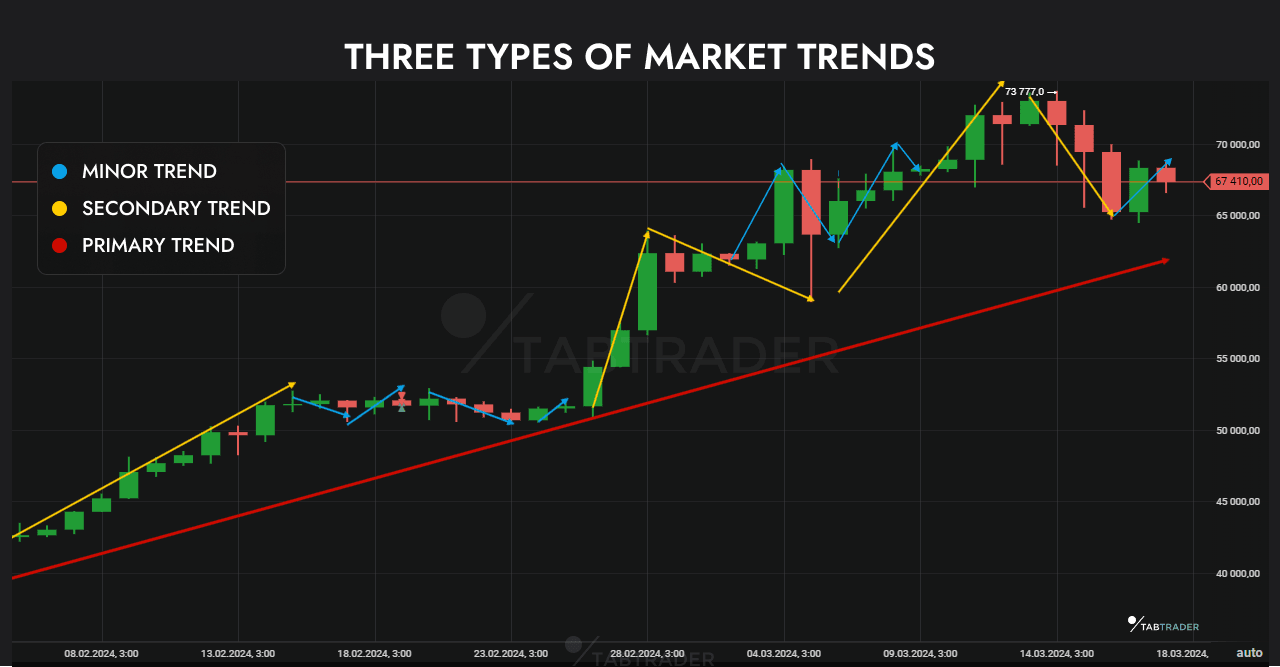
There Are Three Types of Market Trends
Dow Theory identifies three types of market trends:
- Primary Trend – the longest and most important trend, usually lasting a year or more. It reflects the overall market direction, either upward (bullish) or downward (bearish). Primary trends are generally unaffected by short-term fluctuations and attract long-term investors' attention.
- Secondary Trend – a corrective movement within the primary trend. This trend usually lasts from a few weeks to several months and moves against the primary trend. In an upward primary trend, secondary trends will move downward, and vice versa.
- Minor Trend – short-term price fluctuations occurring within secondary trends. These changes typically last no more than three weeks. While minor trends may offer some short-term trading opportunities, they are considered less significant in the broader context of market analysis compared to primary and secondary trends.
Primary Trends Have Three Phases
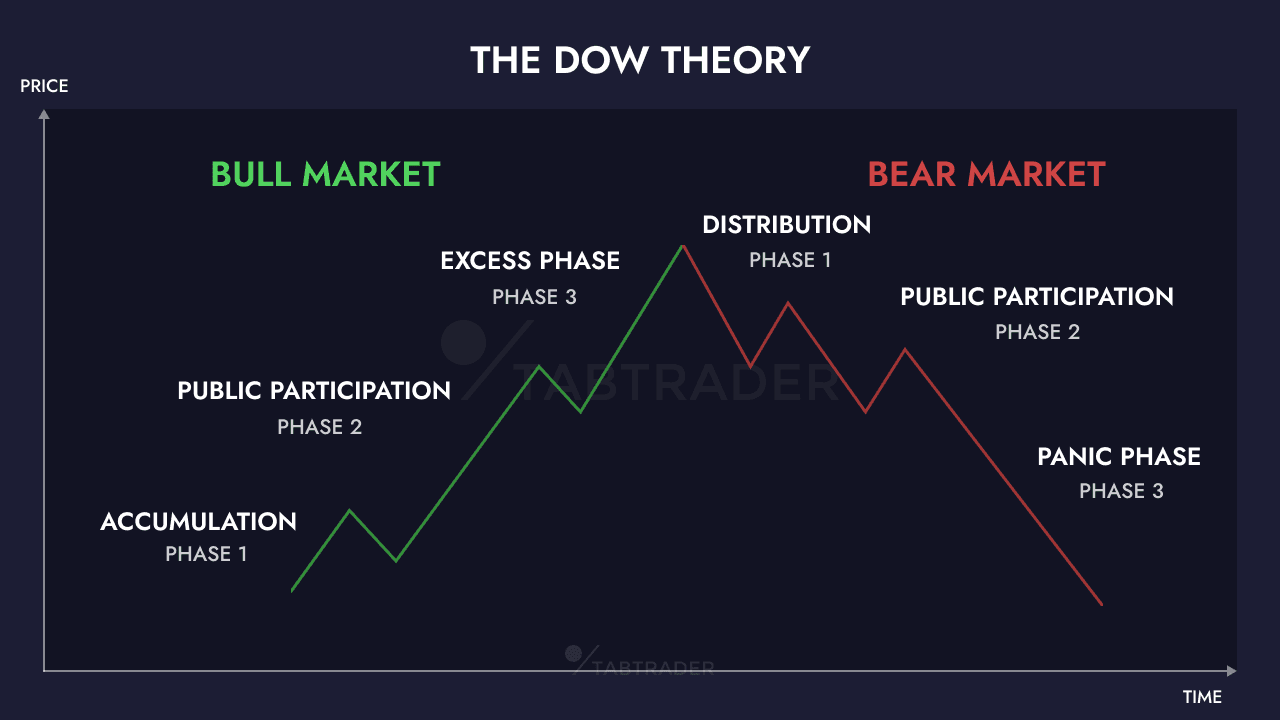
The third tenet of the Dow Theory states that every primary trend is divided into three distinct phases.
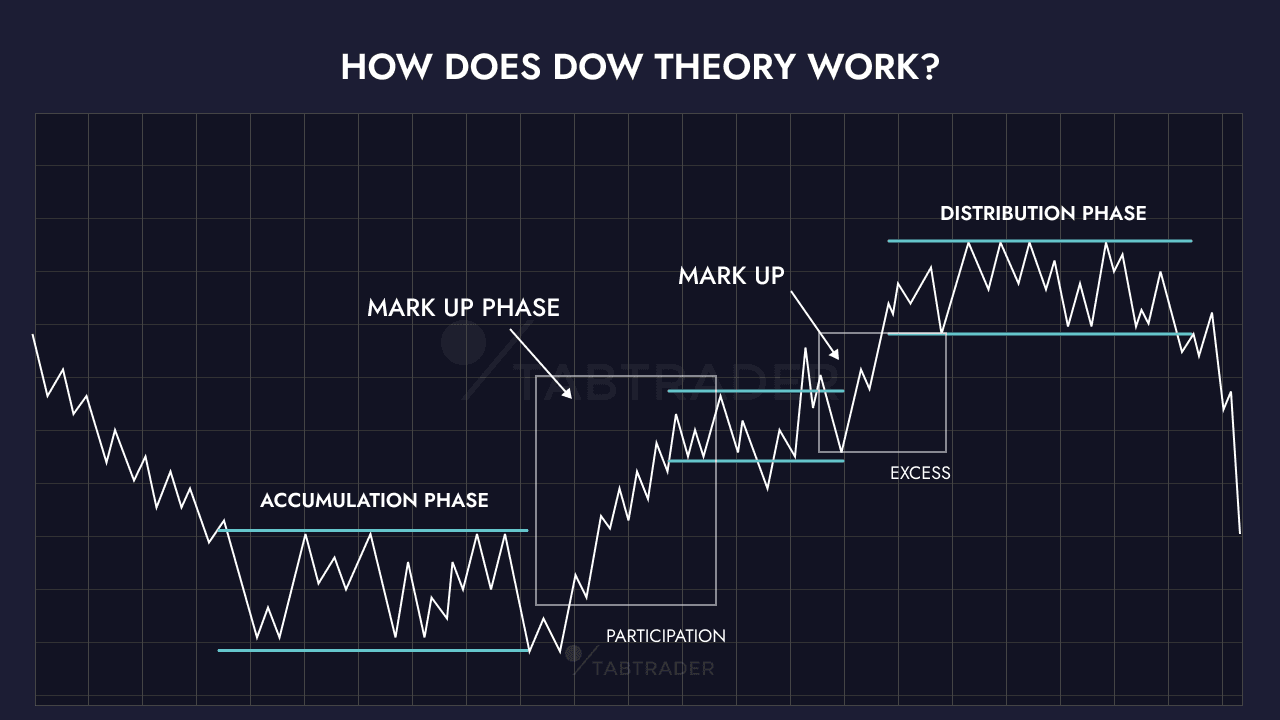
In Bull Markets:
- Accumulation Phase: In this phase, well-informed investors start accumulating undervalued assets, anticipating increased demand.
- Public Participation Phase: Following the accumulation phase, as optimism spreads, more and more market participants buy these assets, driving prices higher.
- Distribution Phase: Near the end of the bull trend, when prices peak, savvy investors begin closing positions, locking in profits.
In Bear Markets:
- Distribution Phase: The bear market begins with a phase similar to the one that ends the bull market. Prices may still be high, but informed investors have already started selling.
- Public Participation Phase: In this phase, the downward trend becomes more apparent as a larger portion of investors start selling, further driving prices down.
- Panic Phase: The culmination of the bear market, characterized by panic selling. Experienced investors, however, often look for opportunities to re-enter the market, anticipating a potential trend reversal.
Stock Market Indexes Must Confirm Each Other
This principle states that for a market trend to be considered valid, it must be confirmed by movements in multiple major indexes. If the main indexes point in opposite directions, the reliability of the trend can be questioned.
Charles Dow originally used two indexes: the Dow Jones Industrial Average (DJIA) and the Dow Jones Transportation Average (DJTA).
In today’s financial markets, although Dow’s idea still holds true at its core, relying solely on these two indexes is insufficient to capture all market trends. Modern markets are far more complex, with a wide range of indexes and asset classes that provide a broader view of market movements.
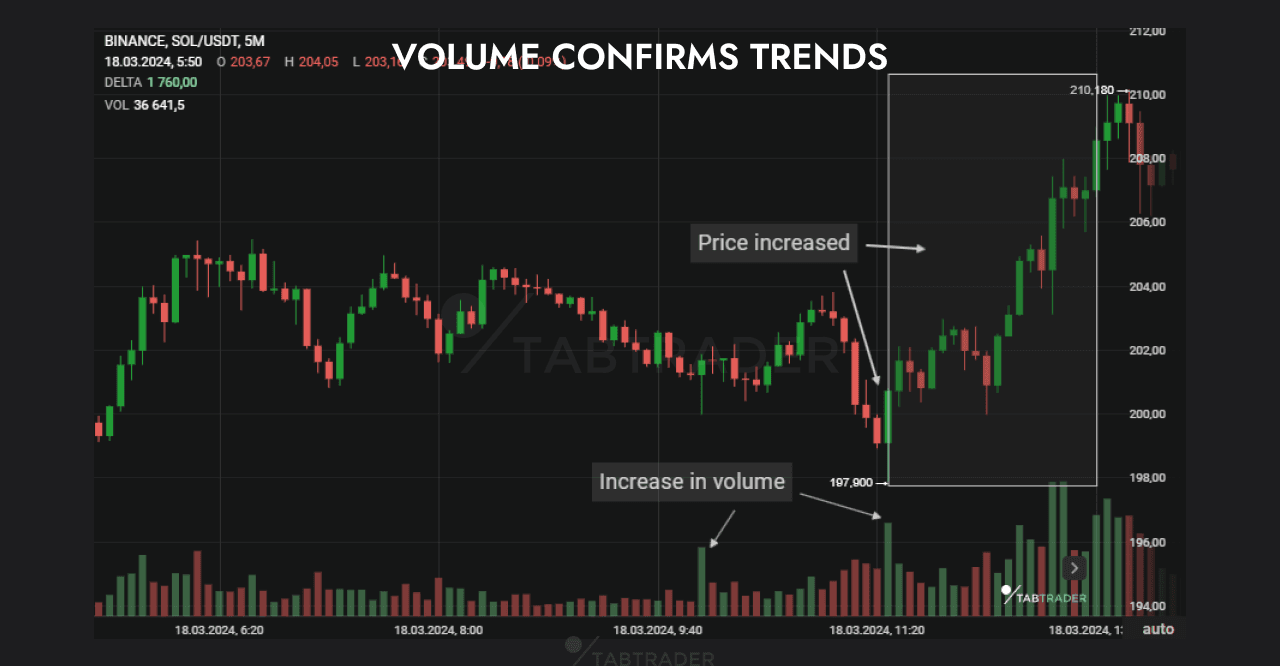
Trends Are Confirmed by Trading Volume
According to the Dow Theory, trading volumes must align with price movements—only then can a market trend be considered confirmed. Essentially, for a trend to be deemed reliable, trading volume should support price movement in the direction of the primary trend.
For example, during an uptrend, rising prices should be accompanied by increasing volume, while falling prices should see decreasing volume. If prices move in the direction of the primary trend but volume declines, this indicates a potential weakening of the trend or even a possible reversal.
Even today, confirming trends through trading volume analysis remains one of the key techniques for traders and investors.
Trends Continue Until a Clear Reversal Signal Appears
This principle states that once a market trend is established, it will continue until there is clear evidence that it has ended. Traders and investors are warned not to jump to conclusions based on minor fluctuations or temporary reversals. Instead, they should wait for definite confirmation that the trend has concluded before adjusting their investment strategy.
Applying the Dow Theory in Trading
Here’s how traders can apply Dow Theory principles to build a practical trading strategy:
- Identify the Primary Trend: The first step is to recognize the primary trend in the market. Traders using Dow Theory analyze long-term price charts, looking for recurring patterns of higher highs and higher lows in uptrends, and lower highs and lower lows in downtrends.
- Confirm the Trend: Once the primary trend is identified, traders seek confirming signals. According to Dow Theory, a trend is validated when it aligns with the movement of two or more major indexes. Additionally, rising trading volume in the direction of the trend can serve as confirmation.
- Recognize Secondary Trends: Secondary trends occur within primary trends but move in the opposite direction. These corrections often provide opportunities to enter the market at more favorable prices. For example, in an uptrend, a temporary dip during a secondary trend can be a good moment to buy before the upward trend continues.
- Look for Trend Reversals: When traders notice signs of weakening or reversal—such as changes in trading volume or a break of key support/resistance levels—they can adjust positions or initiate new trades in line with the emerging trend.
It’s important to note that, as with any trading strategy, risk management is crucial when applying Dow Theory. Traders should set stop-loss orders to minimize potential losses if the market turns unfavorable and carefully size their positions.
Conclusion
Much of what we know today about technical analysis has grown out of the Dow Theory. By introducing the world to fundamental concepts such as market trends, signal confirmation, and market cycles, Dow Theory laid the foundation for many tools and techniques that traders use today.
Thanks to its simplicity, Dow Theory can be applied by traders of all experience levels. Moreover, its focus on the fundamentals of market dynamics, common across various trading environments, allows the theory to be used for different asset classes and timeframes.
It is important to remember, however, that like any technical analysis tool, Dow Jones Theory has its limitations. To enhance its effectiveness, traders can combine it with other analytical instruments, such as moving averages and momentum oscillators.
Add new comment